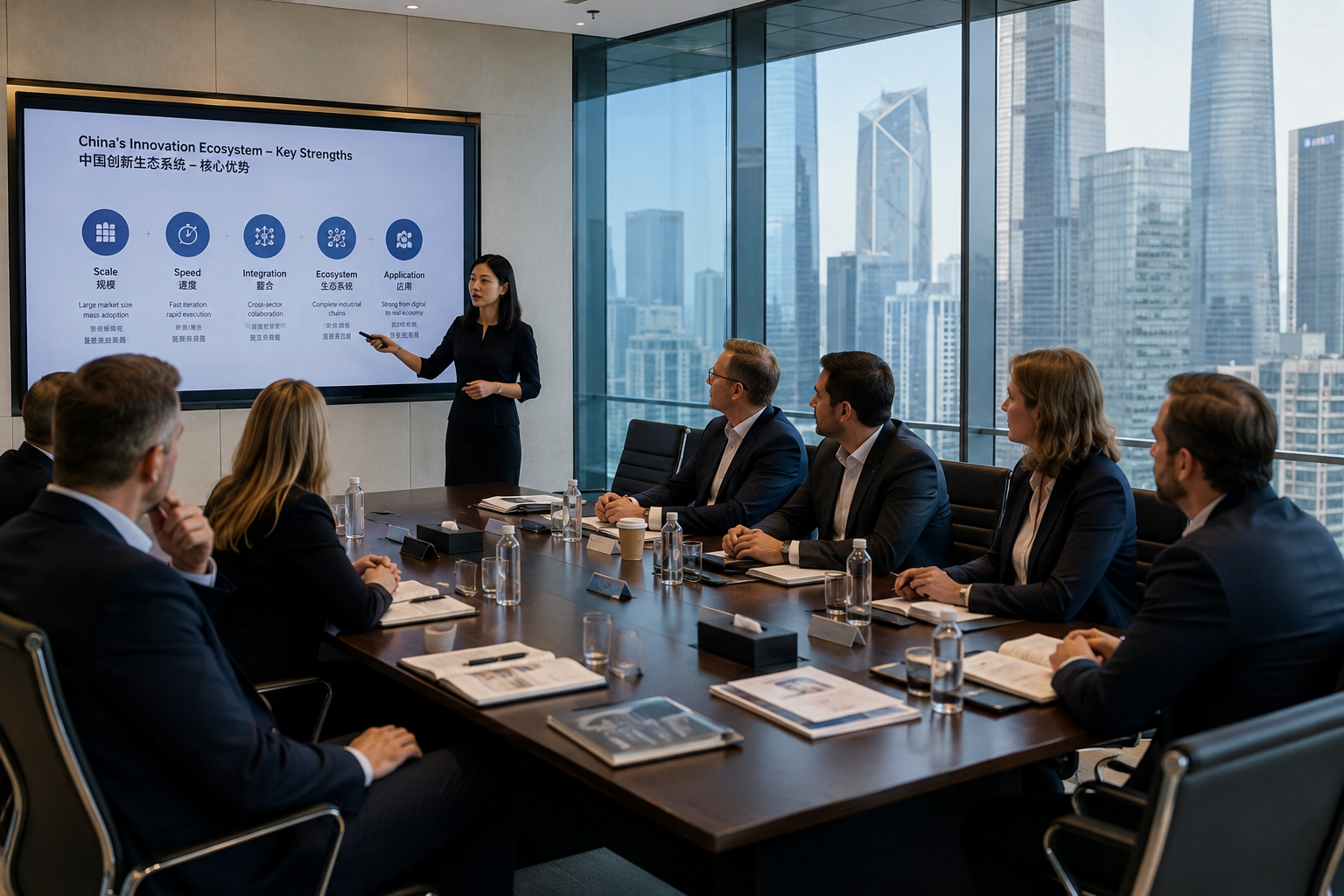
China Study Tours Are Evolving into Business Immersion
China is no longer just a destination to visit.
For global executives, business schools, investors, founders and corporate strategy teams, China has become a business environment to understand. Its companies, supply chains, digital platforms, manufacturing systems and innovation ecosystems are shaping conversations far beyond China itself.
This is why search interest around terms such as China study tour, China executive study tour, China corporate visit, China business delegation and even China Study Tour .ai has become more visible. Platforms such as chinastudytour.ai reflect a wider market signal: international organisations are actively looking for structured ways to see China first-hand.
But the real question is no longer simply how to find a China study tour.
The more important question is what kind of learning experience a China visit should become.
For BvisChina, the answer is clear: a serious China study tour for executives should evolve into a China business immersion.
From Study Tour to Business Understanding
Traditionally, a China study tour often meant a combination of company visits, university exchanges, city exploration and cultural activities.
That model still has value, especially for schools, universities and general learning groups.
But for executives and organisations, the expectation is changing.
A senior team visiting China does not only want to “see” companies. They want to understand how Chinese companies operate, how ecosystems connect, how technology is deployed, how supply chains support speed and how China’s business environment differs from outside assumptions.
This requires more than an itinerary.
It requires context, preparation, interpretation and reflection.
A China business immersion connects company visits with industry logic. It connects factory floors with supply chain systems. It connects AI demonstrations with real deployment. It connects EV companies with battery ecosystems, charging infrastructure and user adoption. It connects robotics and smart manufacturing with industrial upgrading and regional production networks.
The purpose is not sightseeing.
The purpose is strategic understanding.
Why First-Hand Learning Matters
Reports are useful. Market data is useful. News analysis is useful.
But China cannot be fully understood from a distance.
A report can describe China’s EV market. A first-hand visit can show how fast product iteration happens, how suppliers cluster around manufacturers, how battery systems shape business models and how competition affects execution.
A report can describe China’s AI ecosystem. A business immersion can show how AI is moving from models and demos into enterprise workflows, smart cities, mobility, healthcare, education and manufacturing.
A report can describe China’s manufacturing upgrade. A smart manufacturing visit can show how automation, robotics, hardware ecosystems, industrial software and regional supplier networks interact in practice.
For global executives, these differences matter.
First-hand learning helps leaders ask better questions. It challenges assumptions. It makes abstract market trends concrete. It allows teams to compare systems, not only products.
China’s Business Landscape Is Ecosystem-Driven
One of the most important features of China’s business landscape is ecosystem competition.
In many industries, the real advantage is not only one company, one product or one technology. It is the speed at which companies can connect suppliers, software, hardware, infrastructure, talent, logistics, local partners, platforms and customer feedback.
This is visible across China’s AI ecosystem, electric vehicle industry, robotics sector, smart manufacturing base, digital economy and green energy transition.
For international decision-makers, this means that a single company visit is useful, but not sufficient.
A China corporate visit becomes strategically valuable when it helps participants understand the wider system around the company.
How does the company work with suppliers?
How does the local industrial ecosystem support speed?
How does technology move from pilot to deployment?
How do customers influence product iteration?
How do cities, industrial parks and companies reinforce each other?
These are the questions that turn a China company visit into a serious learning experience.
China AI Study Tour: Beyond the Hype
Artificial intelligence is one of the strongest reasons why global executives are paying attention to China.
But a China AI study tour should not focus only on models, product demos or company names.
The deeper question is how AI is being deployed.
In China, AI is increasingly connected to autonomous driving, smart cities, enterprise services, manufacturing, logistics, customer service, education, healthcare and digital platforms.
A serious China AI business immersion may explore:
enterprise AI adoption;
autonomous driving and robotaxi development;
smart city applications;
AI in manufacturing and logistics;
AI in healthcare and education;
AI governance and business implications;
the difference between AI hype and AI deployment.
For international leaders, China’s AI story is not only a technology story. It is an implementation story.
China EV Study Tour: Understanding the System Behind the Cars
China’s electric vehicle industry is one of the clearest examples of ecosystem-level competition.
A China EV study tour should not only focus on visiting EV brands. It should help participants understand the system behind the industry.
This includes batteries, charging infrastructure, software, manufacturing speed, supplier coordination, product iteration, user experience, cost structure and policy environment.
Companies such as BYD, CATL, NIO and other players represent different parts of this transformation. But the real learning comes from understanding how those parts connect.
For European manufacturers, suppliers, investors and policymakers, China’s EV ecosystem is not only something to observe. It is something to study carefully.
The value of a China EV supply chain visit lies not only in access to companies, but in understanding why the ecosystem moves so quickly.
China Robotics and Smart Manufacturing Tour
China’s manufacturing story is changing.
The old image of Chinese manufacturing as only low-cost and large-scale is outdated.
Today, China’s industrial landscape increasingly includes robotics, automation, digital supply chains, smart factories, industrial software, humanoid robotics, industrial IoT and flexible production systems.
A China robotics study tour or China smart manufacturing tour can help executives understand how Chinese companies are upgrading production and integrating technology into industrial environments.
Important questions include:
How are factories using automation?
How are robotics companies moving from prototype to deployment?
How do Shenzhen, Dongguan, Suzhou and other manufacturing hubs support industrial innovation?
How do hardware ecosystems shorten the path from design to production?
How does supplier density support speed?
For executives in manufacturing, logistics, hardware, industrial technology and operations, these questions are not theoretical. They can inform strategy, sourcing, innovation and competitiveness.
China Digital Economy and Platform Business
China’s digital economy remains one of the most important fields for international business learning.
E-commerce, livestream commerce, digital payments, super apps, logistics, short video platforms, local services, online-offline integration and consumer data have created a business environment that differs from many Western markets.
A China digital economy tour or China market immersion programme can help international teams understand how platforms influence consumer behaviour, brand building, distribution and service delivery.
For business schools, consumer brands and corporate innovation teams, this is often one of the most useful parts of a China executive learning journey.
The goal is not to copy China’s platforms directly.
The goal is to understand the operating logic behind them.
Access Alone Is Not Enough
Many international teams begin with a simple search: China company visit, China corporate visit, BYD factory visit, Huawei company visit, DJI headquarters visit, Alibaba visit or China factory visit tour.
These searches are understandable. Famous companies create attention.
But access alone does not automatically create insight.
A company visit can become superficial if it is not properly framed. Participants may see an office, a showroom or a factory floor without understanding the system behind it.
A valuable China corporate visit requires preparation, context, moderation, translation, industry interpretation and post-visit reflection.
Before the visit, participants need to understand what they are looking for.
During the visit, they need to ask better questions.
After the visit, they need to connect what they saw to their own business priorities.
That is the difference between a standard China study tour and a serious China business immersion.
Why BvisChina Takes a Different Approach
At BvisChina, we believe that a China study tour should not be reduced to a list of destinations.
A serious China business immersion should be designed around strategic questions.
What does the client need to understand?
Which industries matter most?
Which cities reveal the right part of the ecosystem?
Which company visits will create meaningful learning?
What preparation is needed before the visit?
How should participants reflect after the visit?
How can the experience support better business decisions?
BvisChina designs China business immersion programmes, executive study tours, corporate visits and industry benchmarking journeys for international organisations seeking first-hand insight into China.
Our work combines:
China corporate visits and company visits
China business delegation planning
China AI study tour modules
China EV supply chain visits
China robotics and smart manufacturing tours
China digital economy briefings
China market immersion programmes
China innovation ecosystem tours
industry benchmarking visits
bilingual facilitation and cross-cultural interpretation
post-visit insight synthesis
We help clients move beyond generic tours and into structured executive learning.
Who Should Consider a China Business Immersion?
A China business immersion programme is especially relevant for:
global executives seeking first-hand China market understanding;
European companies studying China’s innovation and manufacturing ecosystems;
business schools planning MBA or EMBA China study tours;
corporate strategy and innovation teams exploring AI, EVs or robotics;
investors and founders studying China’s technology ecosystem;
industry associations organising China business delegations;
manufacturers and suppliers interested in China’s industrial upgrade;
international organisations looking for China corporate learning programmes.
For each group, China represents a different question.
For some, it is a market.
For others, it is a competitor.
For others, it is a partner, supplier base, innovation lab or learning ground.
BvisChina helps clarify what China means for each client.
Suggested Programme Themes
A strong China business immersion programme should be designed around business relevance, not only around famous company names.
Possible themes include:
China AI Business Immersion
Understanding AI deployment, enterprise adoption, smart city applications, autonomous driving and industrial AI use cases.
China EV and Battery Supply Chain Visit
Exploring BYD, CATL, battery technology, charging infrastructure, new energy vehicles and the competitive logic of China’s EV ecosystem.
China Robotics and Smart Manufacturing Tour
Studying automation, robotics, smart factories, industrial IoT, flexible production and China’s manufacturing upgrade.
China Digital Economy and Platform Business
Understanding e-commerce, livestream commerce, digital payments, consumer platforms and online-offline integration.
China Green Economy and ESG Visit
Exploring renewable energy, solar supply chains, battery storage, industrial decarbonisation and sustainable manufacturing.
China Innovation Ecosystem Tour
Observing how cities such as Shenzhen, Shanghai, Beijing, Hangzhou, Suzhou, Guangzhou and Dongguan support different forms of innovation and industrial development.
City Focus: Where to Understand China
Different Chinese cities reveal different parts of the business landscape.
Beijing is important for AI, policy, universities, technology companies, digital platforms and executive briefings.
Shanghai is important for finance, multinational companies, EVs, consumer brands, professional services and global business context.
Shenzhen is important for hardware, robotics, EVs, consumer electronics, DJI, BYD, Huawei, Tencent and fast-moving innovation ecosystems.
Hangzhou is important for Alibaba, digital economy, e-commerce, fintech, cloud services and platform business.
Suzhou is important for industrial parks, advanced manufacturing and China-Europe business context.
Guangzhou and Dongguan are important for manufacturing, supply chains, smart factories, trade fairs, hardware production and industrial upgrading.
A strong China business delegation connects cities into a coherent learning journey instead of treating them as disconnected stops.
From Search Interest to Serious Learning
The growing search interest around China study tour reflects a real market shift.
More international teams want structured ways to understand China. But the next stage of this market will not be won by keyword visibility alone.
It will be won by trust, depth, relevance and the ability to turn access into understanding.
For global executives, the value of coming to China is not only to collect information. It is to challenge assumptions, compare systems, ask better questions and understand how business works on the ground.
This is especially important in sectors such as AI, EVs, robotics, smart manufacturing, digital economy and green energy, where China’s development speed and ecosystem logic often differ from outside expectations.
Conclusion: China Study Tours Are Becoming Business Immersion
The phrase China study tour is evolving.
For schools and universities, it may still mean education, culture and international exposure.
For executives and organisations, it increasingly means something more strategic: China business immersion, corporate learning, industry benchmarking and market understanding.
That shift matters.
China cannot be fully understood through headlines, reports or distant observation.
To understand China’s AI deployment, EV supply chains, robotics manufacturing, digital platforms, smart cities and innovation ecosystems, leaders need to come closer. They need to see, ask, listen, compare and reflect.
BvisChina exists to make that process more structured, more meaningful and more valuable.
We help global executives and organisations turn a visit to China into a serious business learning journey.
Contact BvisChina to design your China business immersion, executive study tour, corporate visit or business delegation programme.